The Infamous “Toilet Flush” Freeze-Out
Picture this. You are enjoying a perfectly warm morning shower. Suddenly, someone in the powder room flushes the toilet, or the washing machine kicks into its fill cycle. In an instant, your relaxing warm water transforms into a scalding hazard or an ice-cold shock to the system.
We have all been there. But if you are planning a bathroom remodel, you don’t ever have to be there again.
When homeowners sit down with our team to map out a luxurious spa-like bathroom, the conversation eventually shifts from tile aesthetics to plumbing hardware. Two upgrades constantly come up: thermostatic valves and smart showers.
Both promise a flawless shower experience. Both cost more than your standard builder-grade plumbing. But are they actually worth the premium price tag, or are you just paying for a fancy dial? Let’s strip away the marketing jargon and look at the real-world utility, mechanics, and value of these systems.
Standard vs. Thermostatic Valves: The Mechanical Reality
To understand why a thermostatic valve costs more, you have to understand what it replaces.
Most standard homes are built with a pressure-balancing valve. This mechanism works exactly how it sounds: it balances water pressure. If the cold water pressure drops (because someone flushed that toilet), the valve automatically restricts the hot water pressure to match it.
This prevents you from getting scalded, but it dramatically drops your water volume and changes the temperature. It’s reactive, and frankly, a bit clunky.
Enter the thermostatic mixing valve.
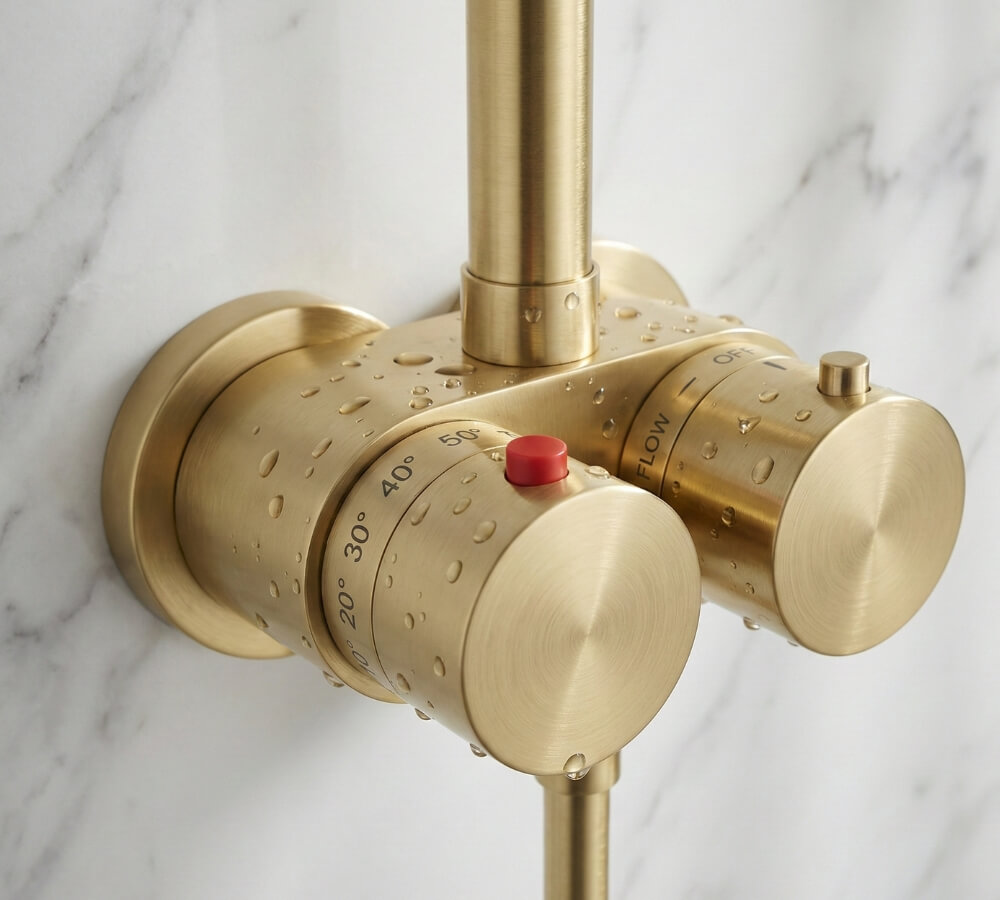
Instead of just balancing pressure, a thermostatic valve actively controls the temperature. Inside the valve is a highly sensitive element (usually containing wax or a specialized liquid) that instantly expands or contracts in response to the water temperature.
Here is why this matters for your daily life:
- Pinpoint Accuracy: You set the dial to your exact preferred temperature (say, 38°C). The valve mixes the hot and cold lines to hit that exact number, regardless of pressure fluctuations elsewhere in the house.
- Volume Control: Thermostatic systems usually split volume and temperature into two separate dials. You can keep your perfect temperature locked in place day after day, and simply use the volume handle to turn the shower on and off.
- The Safety Factor: If your cold water supply completely fails, the thermostatic valve shuts off the hot water in a fraction of a second. This anti-scald technology is a massive peace-of-mind upgrade for households with young children or elderly family members.
The Digital Leap: What Does a “Smart Shower” Actually Do?
If a thermostatic valve is the mechanical MVP, a smart shower is the digital command center.
Smart showers take the concept of thermostatic control and digitize it. Instead of turning a physical brass valve, you interact with a digital keypad, a smartphone app, or even voice commands to control a remote digital valve hidden in your wall or ceiling. When considering integrating smart technologies into your home, the shower is arguably where you will feel the daily impact most.
But what are you actually paying for? Here are the concrete features that separate smart showers from mechanical ones:
- The “Warm-Up and Pause” Feature: This is arguably the best feature of a smart system. You tap a button (or ask your voice assistant) to start the shower. The system runs until the water hits your exact target temperature and then it pauses the flow. You no longer have to stick your hand into the stream to test it, and you aren’t wasting gallons of hot water while you brush your teeth waiting for the shower to warm up.
- Custom User Presets: If you like a 40°C rainfall shower, but your partner prefers a 36°C blast from the wall jets, you can save these as individual profiles. One touch, and the shower configures exactly to your liking.
- Multi-Outlet Orchestration: If you are building a massive walk-in shower with a rain head, a handheld wand, and three body sprays, traditional plumbing requires a complex (and ugly) array of diverter knobs. A smart shower controls all of these outlets from one sleek, minimalist digital pad.

The Cost-Benefit Breakdown: Splurge or Skip?
Let’s talk numbers. Upgrading from a standard pressure-balancing valve to a thermostatic valve system will typically add anywhere from $300 to $800 to your plumbing fixtures budget, depending on the brand (like Moen, Kohler, or Riobel).
Upgrading to a full digital smart shower system (like the Moen U or Kohler Anthem) can add $1,000 to $3,000+ to your budget. This accounts for the digital controller, the remote valve, and the added electrical work required to power the unit.
When to Choose a Thermostatic Valve:
You should absolutely make this upgrade if you are doing a full shower remodel. The extra cost is negligible when factored into a complete renovation, and the return on investment in daily comfort is unmatched. You will never deal with temperature spikes again. It is a no-brainer for primary ensuites.
When to Splurge on a Smart Shower:
A smart shower is worth the premium only if you fall into one of two categories:
- You are designing a custom shower with three or more water outlets. (It simplifies the wall clutter and creates a cleaner aesthetic).
- You prioritize water conservation and modern convenience. High-efficiency fixtures paired with the smart “warm-up and pause” feature can save significant amounts of water annually. In fact, organizations like the EPA’s WaterSense program highlight how advanced fixture technology drastically cuts down on household water waste without sacrificing pressure.

Maintenance Realities You Need to Know
I would not be doing my job if I didn’t warn you about the maintenance caveats.
Mechanical thermostatic valves are highly reliable. If they ever fail or get clogged with hard water deposits, a plumber simply pops off the handle, pulls out the old cartridge, and slides a new one in. It’s a 15-minute fix.
Smart showers, however, rely on circuit boards, Wi-Fi connections, and motorized valves. If the power goes out, you cannot take a shower unless your system has a battery backup installed. Furthermore, the digital valve must be installed in an accessible location (like behind a panel in an adjoining closet) because repairing a motorized valve buried behind custom tile is a nightmare. Always hire a contractor who understands the specific rough-in requirements of digital plumbing.
The Final Verdict on Shower Upgrades
A shower isn’t just a place to get clean; for most of us, it is the only 10 minutes of uninterrupted peace we get all day.
If you are already investing the time and money into a bathroom renovation, upgrading to a thermostatic valve is absolutely worth the extra cost. It is a fundamental improvement to your home’s plumbing that you will physically feel every single day.
Smart showers, on the other hand, are a luxury, not a necessity. They are a brilliant addition to a high-end, multi-jet custom shower where controlling the water flow mechanically would result in an ugly, cluttered wall. But for a standard single-head shower, the digital leap might not justify the steep price tag for the average homeowner.
Are you ready to map out the plumbing and design details for your next home project? Let’s make sure your budget is going exactly where it matters most. Reach out to our design team at Kitchen and Bath Reno today, and let’s start planning a space that actually works for you.