If you are planning a bathroom renovation in Toronto or the GTA this year, the question of heated floors will come up the moment a contractor walks the space. It is the most-requested upgrade on GTA bathroom projects, and the one homeowners ask the most questions about. The honest answer is that heated floors are worth it on most full bathroom renovations, but the right system, the right install timing, and the real running cost depend on details most contractors gloss over. Here is what every GTA homeowner should know before signing off on the rough-in.
We recently handled kitchen renovation in Mississauga for a client where we integrated in-floor heating seamlessly during the build, and the difference in comfort and overall finish was immediately noticeable.
The two systems: electric mat vs hydronic loop
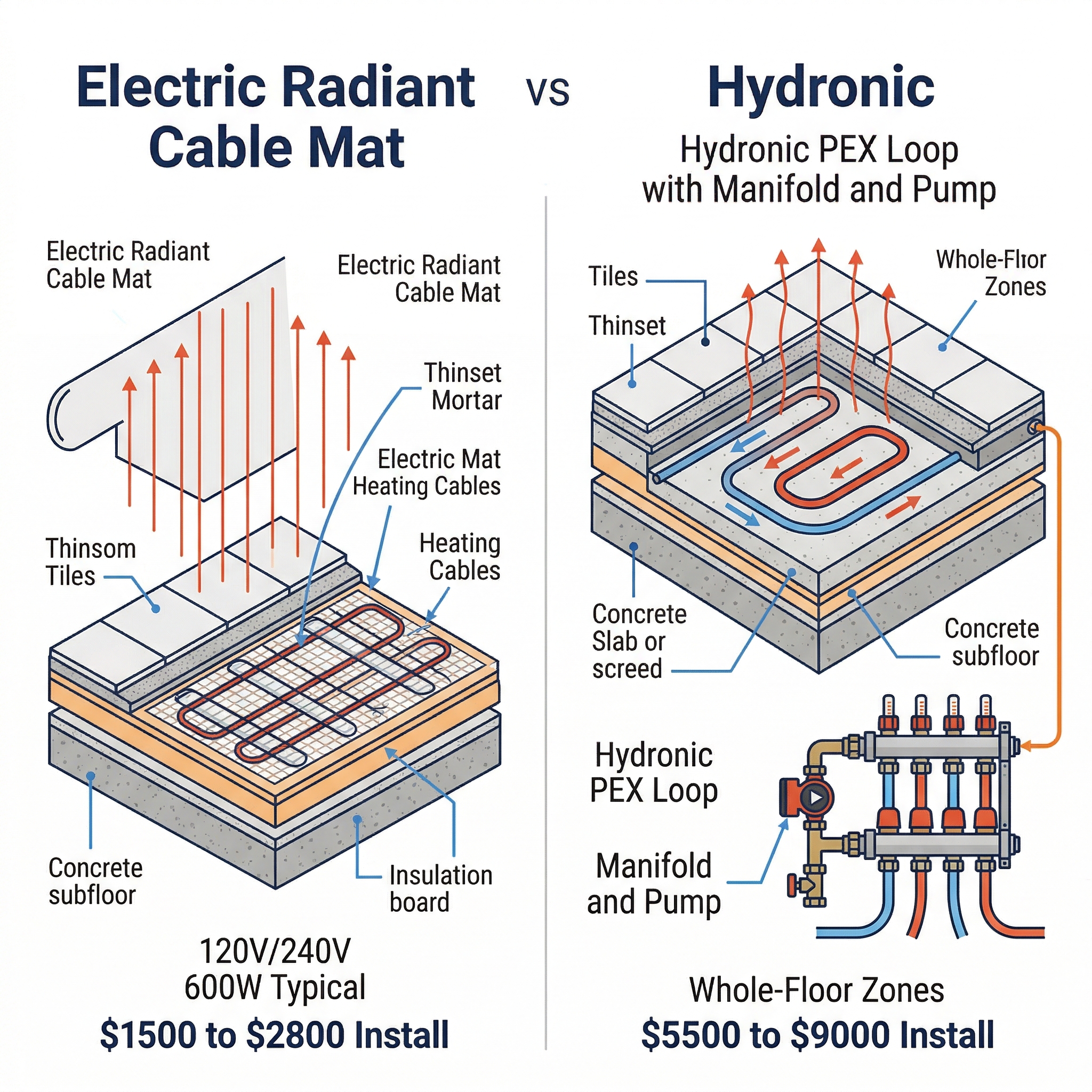
Almost every heated floor in a GTA bathroom uses one of two technologies. They cost different amounts to install, run, and repair, and the right choice depends on the size of the space and whether you are heating one room or several.
Electric radiant mats
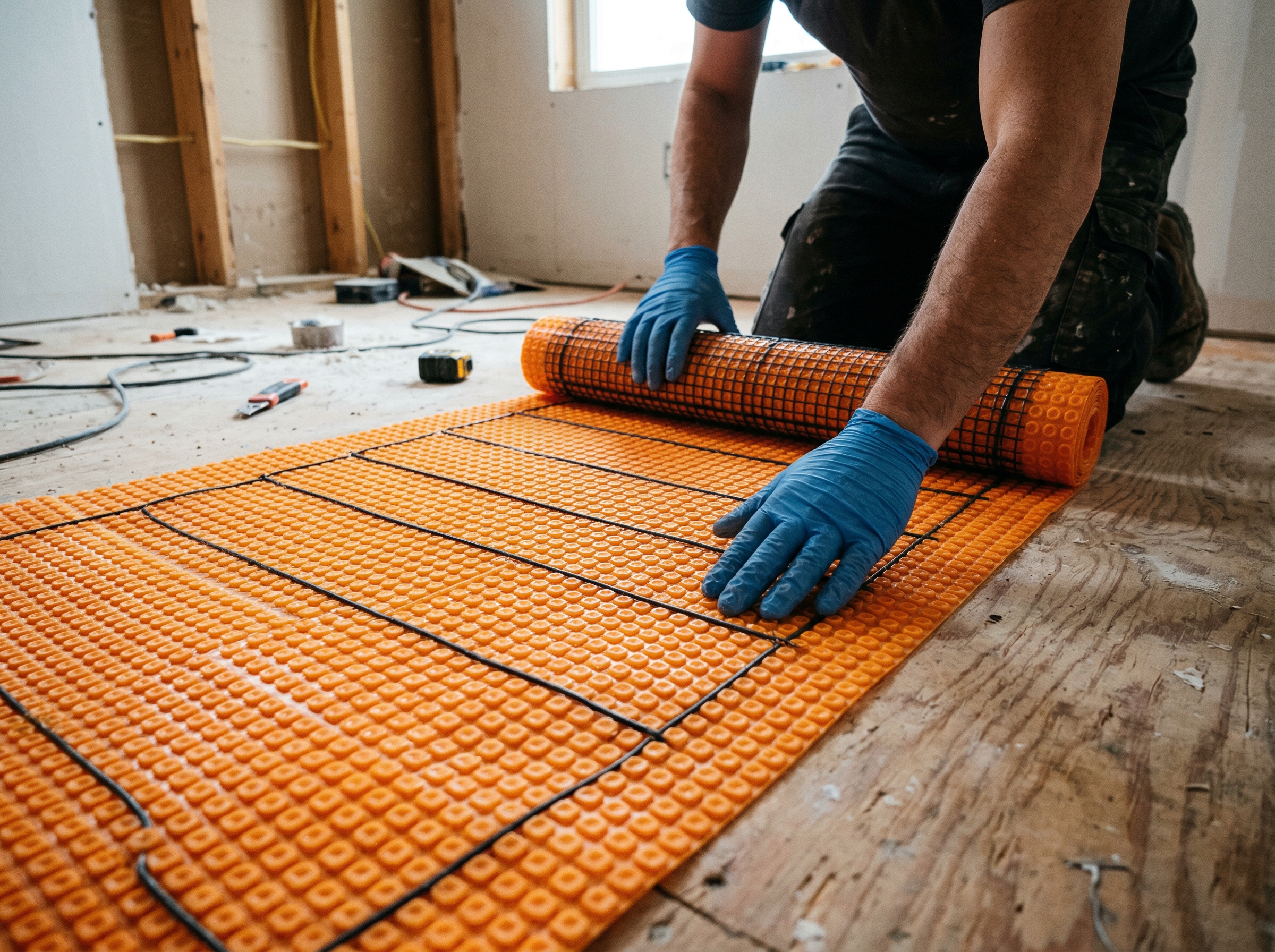
A thin mesh mat with a heating cable woven into it gets rolled out over the subfloor (or over a Schluter Ditra-Heat uncoupling membrane), wired to a thermostat with a built-in floor sensor, and tiled over. The cable runs at 120V or 240V depending on the size. For most GTA bathrooms (40 to 80 sq ft of floor), a single 120V mat handles the whole room. Brands like Schluter Ditra-Heat, WarmlyYours, and Nuheat dominate the market. Install is straightforward for any tile setter, but the electrical hookup needs a licensed electrician and an ESA inspection.
Hydronic in-floor heat
PEX tubing carries warm water from a boiler or a dedicated electric water heater through loops embedded in the floor. The system needs a manifold, a circulator pump, and a heat source. It is overkill for one bathroom but makes excellent sense if you are doing a full main-floor renovation that includes a bathroom, an open-concept kitchen, and a mudroom on a single hydronic zone. Hydronic floors are cheaper to run per square foot than electric, but the up-front equipment cost is much higher and the system only pays back at scale.
Real 2026 install costs in the GTA
Pricing depends on floor area, the type of mat or tubing, the thermostat choice, and whether you need a new electrical circuit or panel space. Here are the rough numbers a GTA bathroom contractor will quote in 2026:
Electric mat (most common)
- Materials. $12 to $20 per sq ft for a name-brand mat plus uncoupling membrane.
- Programmable WiFi thermostat. $200 to $450.
- Tile setter labour. Built into the tile install bid, usually adds $200 to $500 for the additional layer.
- Licensed electrician + dedicated 20A circuit. $400 to $900 if the panel has space, more if a sub-panel or upgrade is needed.
- ESA inspection fee. $90 to $150.
- Total for a typical 50 sq ft GTA bathroom. $1,500 to $2,800 all-in.
Hydronic (whole-floor systems)
- $15 to $30 per sq ft for tubing, manifold, pump, and labour.
- Plus the heat source: a dedicated electric boiler ($1,500 to $3,500) or a tap into an existing high-efficiency gas boiler ($800 to $2,000 for the tie-in and controls).
- Total for a 200 sq ft hydronic zone covering kitchen, bath, and mudroom: $5,500 to $9,000 all-in.
Monthly running cost on a GTA Toronto Hydro bill
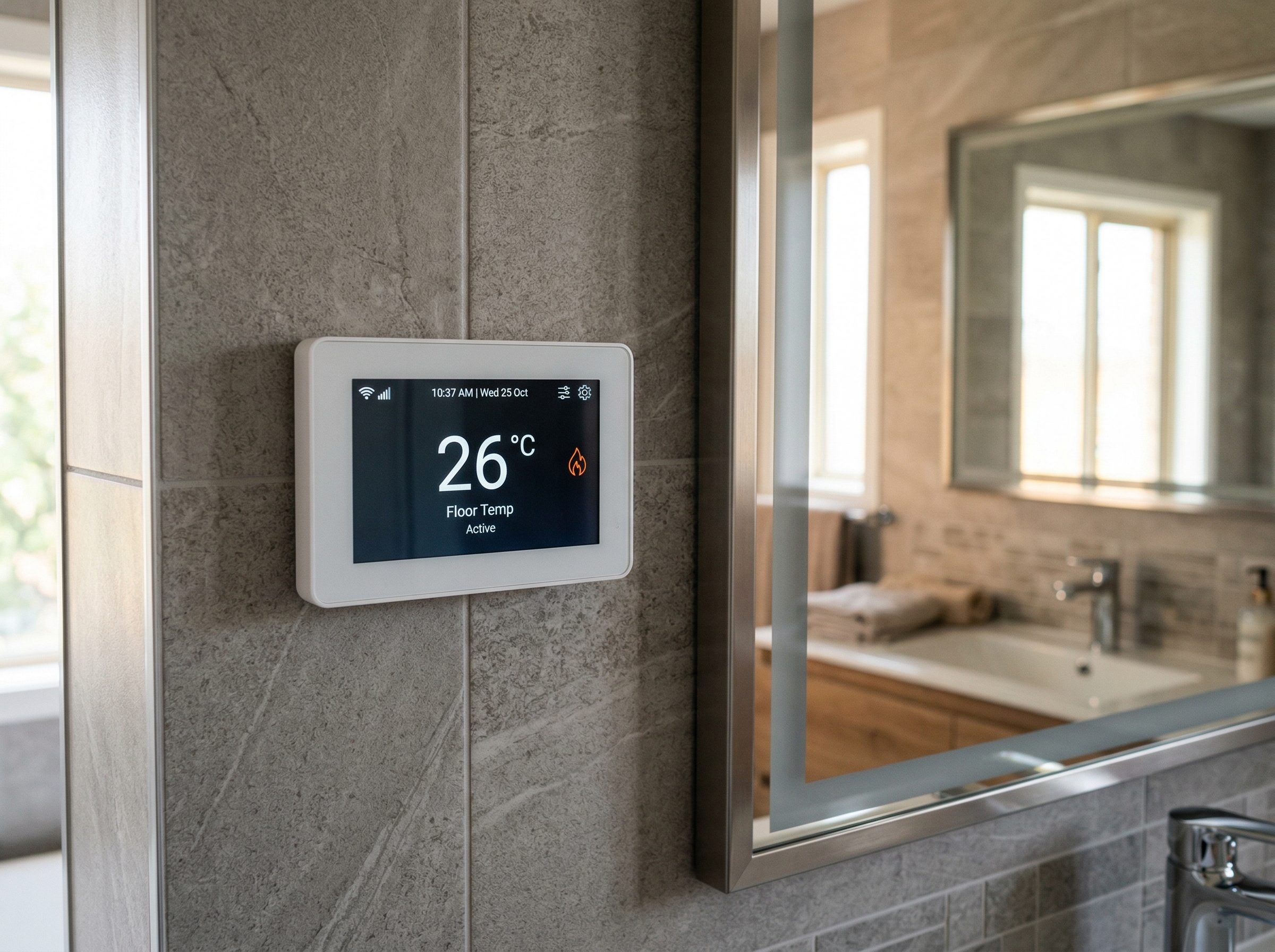
This is where most homeowners get surprised. A typical 50 sq ft electric heated bathroom floor runs at about 600 watts when actively heating. With a programmable thermostat set to bring the floor up to 26°C (78°F) for 4 hours per day in the morning and evening, that works out to roughly 2.4 kWh per day. At Toronto Hydro’s 2026 average rate of about 12 cents per kWh (off-peak weighted), the floor adds around $9 to $11 to the monthly electricity bill in winter and almost nothing in summer when it’s off.
Hydronic systems running off a gas boiler cost about half that per square foot because gas is cheaper than electricity for heat. But the up-front equipment cost means the breakeven is measured in decades for a single bathroom. Natural Resources Canada publishes the federal energy efficiency comparisons that explain why hydronic only wins at scale.
Code, permits, and inspection in Ontario
Heated floors are regulated under two separate codes in Ontario. The Ontario Building Code O. Reg. 332/12 covers the floor assembly itself: subfloor type, waterproofing, and substrate requirements. The Ontario Electrical Safety Code (enforced by the Electrical Safety Authority) covers the wiring, GFCI protection, and the dedicated circuit. Every electric heated floor install requires:
- A permit from the ESA filed by your electrician before energizing the cable.
- A dedicated 15A or 20A circuit from the panel (no sharing with the bathroom receptacle or lighting).
- GFCI protection at the breaker or thermostat.
- An ESA inspection after install and before final tile cleanup.
If your contractor wants to wire the heated floor into the existing bathroom GFCI circuit, walk away. That is a code violation and an inspection failure waiting to happen.
When in the renovation does the floor go in?
Sequence matters. The heating cable installs after the subfloor is prepped and the uncoupling membrane is down, but before the tile mortar. Skip the membrane and the cable lifespan drops because every floor flex point becomes a stress point on the cable. Schluter and other reputable manufacturers all require their uncoupling membrane (or equivalent) for the warranty to remain valid.
Plumbing rough-in for the toilet flange, tub drain, and shower drain has to be 100 percent finished and pressure-tested before the heating cable goes down, because nobody wants to chop a hole through a $1,800 cable system to chase a leak.
Is the floor worth it on a small powder room?
Honest answer: usually no. A powder room gets used for 90 seconds at a time. The floor never has time to make a real comfort difference. The $1,200 a powder room heated floor adds to the project is better spent on a heated towel rail or upgraded fixtures.
For a primary ensuite with a walk-in shower, a freestanding tub, and a tile floor that gets stepped on first thing every morning, heated floors are the single highest-impact comfort upgrade in a renovation. Almost no GTA homeowner who installs them regrets it.
Can I retrofit a heated floor without redoing the bathroom?
Technically yes, with a thin self-adhesive mat under floating engineered flooring. Realistically no for a tile bathroom: the cable has to sit between the substrate and the tile mortar, which means lifting the tile, which means a full reno. If you wanted heated floors and skipped them on the last renovation, you are looking at adding them on the next one.
Frequently asked questions
How long do electric heated floor cables last?
Reputable name-brand mats carry 25-year warranties on the cable itself. Real-world lifespan with a properly installed uncoupling membrane is 30 years or longer. The thermostat is a 10 to 15 year part and is the most likely component to need replacement.
What happens if the cable fails after the tile is down?
You have two options: live without the heat (the floor still works as a normal tile floor), or pull the tile in the affected zone, splice or replace the cable, and re-tile. The thermostat usually fails first, and that is a 30-minute swap. Cable failures are rare on properly installed systems.
Will heated floors crack my porcelain tile?
Not if the uncoupling membrane is installed. The membrane is what isolates the tile from thermal expansion of the substrate. Skip it and you risk hairline cracks at the grout lines after a few heating seasons. Every reputable GTA tile setter installs the membrane on every heated floor.
Do I need a special thermostat?
Yes. The thermostat must read floor temperature from a sensor embedded in the slab (not air temperature), and it must be GFCI-protected. WiFi smart thermostats are available from every major brand and are worth the extra $100 to $200 for the scheduling control.
Can heated floors be the only heat source for the bathroom?
In a small ensuite with good insulation, yes. In a larger bathroom with an exterior wall and a window, no. The Ontario Building Code requires a primary heating source rated for the room volume, and heated floors are not a substitute for a forced-air register or a baseboard.
Talk to a GTA bathroom renovation contractor about the right system
Heated floors are simple to specify on paper and easy to mess up in the field. The wrong sequence, the wrong electrical hookup, or a missed uncoupling membrane will cost you the warranty and the comfort. request a free quote and we will walk through the right system for your bathroom layout, your panel capacity, and your renovation budget before the demo crew shows up.
Note: All costs are approximate and may vary based on scope, materials, and site conditions- contact us for a detailed quote tailored to your project.