Pot fillers are the most-requested specialty fixture on a kitchen renovation after the apron sink. Every Pinterest board and Houzz gallery shows one mounted over the cooktop on a stainless or matte black swing-arm. They look great. They also represent one of the most over-priced upgrades a GTA homeowner can put on a renovation if the plumbing path is wrong, and one of the best small upgrades in the kitchen if the path is short.
If you’re planning a kitchen renovation in Oakville, Mississauga, Burlington or any other surrounding areas the same plumbing and layout rules apply, especially when planning specialty fixtures like pot fillers. Here is the practical reality of getting a pot filler installed during a kitchen renovation in 2026.
What a pot filler actually does
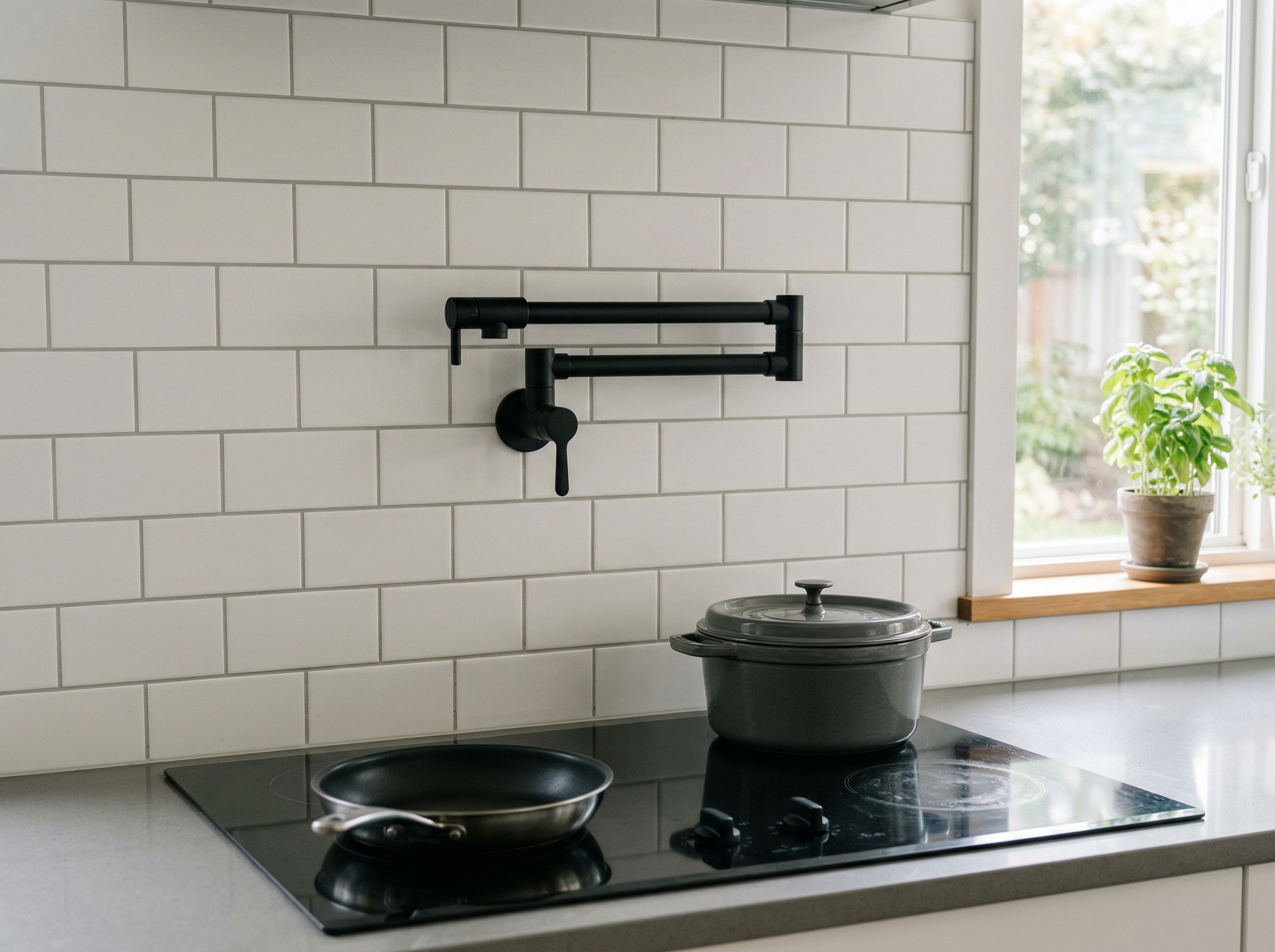
A pot filler is a single-handle (usually two-handle on better units) cold-water faucet on a folding swing arm mounted to the wall behind the cooktop. The arm folds flush to the wall when not in use and swings out over a stockpot to fill it without carrying water from the sink. That is the entire feature set. There is no drain. There is no hot water (on most units). It is a single cold-water tap with a long arm.
The convenience is real on a few specific cooking tasks: filling stockpots for pasta, rice, or stocks; filling Dutch ovens for braises; filling kettles for tea on a gas range. For everything else, it sits folded against the backsplash.
Real 2026 install cost in the GTA
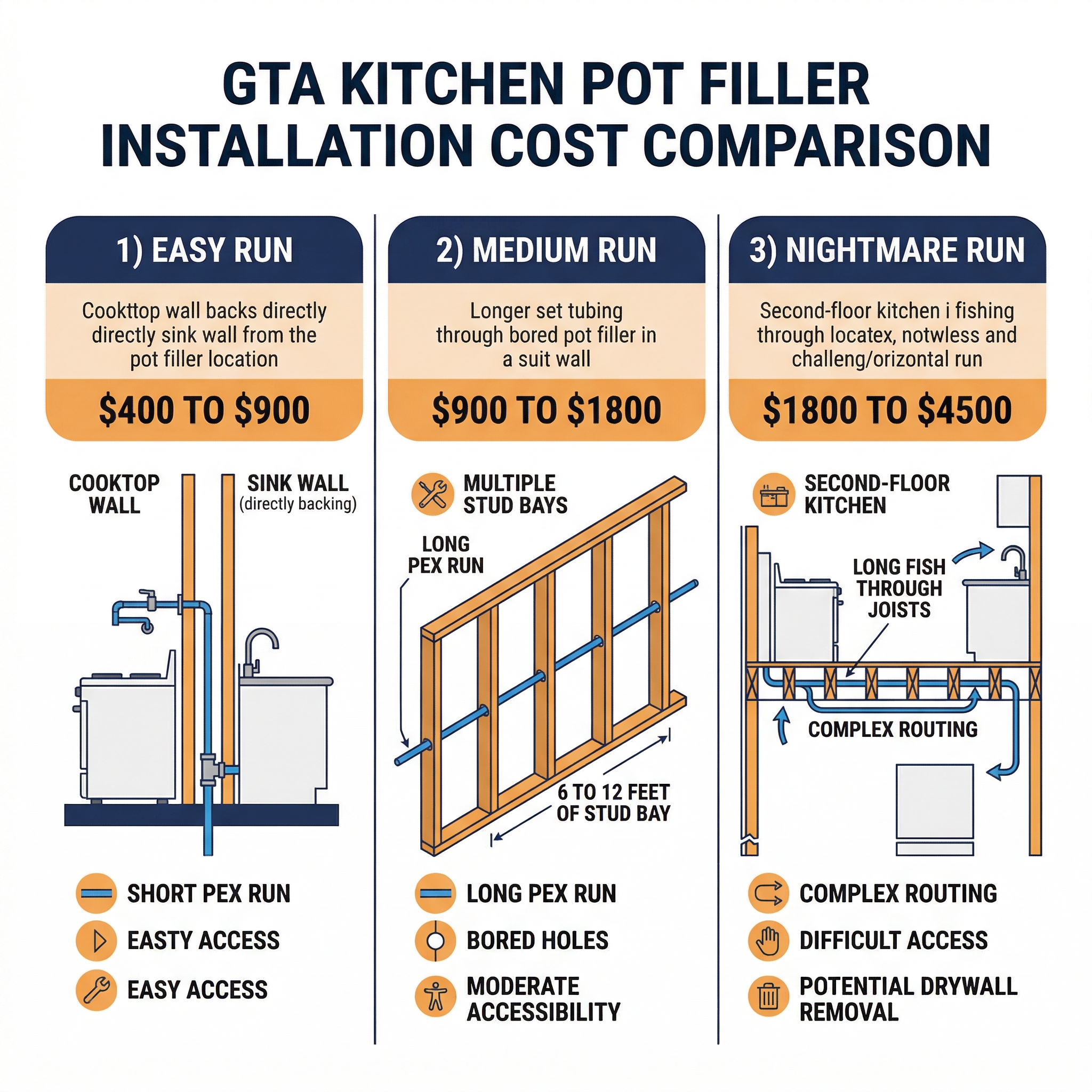
Pricing breaks into three buckets: easy run, medium run, and the nightmare run. The bucket depends entirely on what is on the other side of the wall behind your cooktop.
Easy run ($400 to $900 all-in)
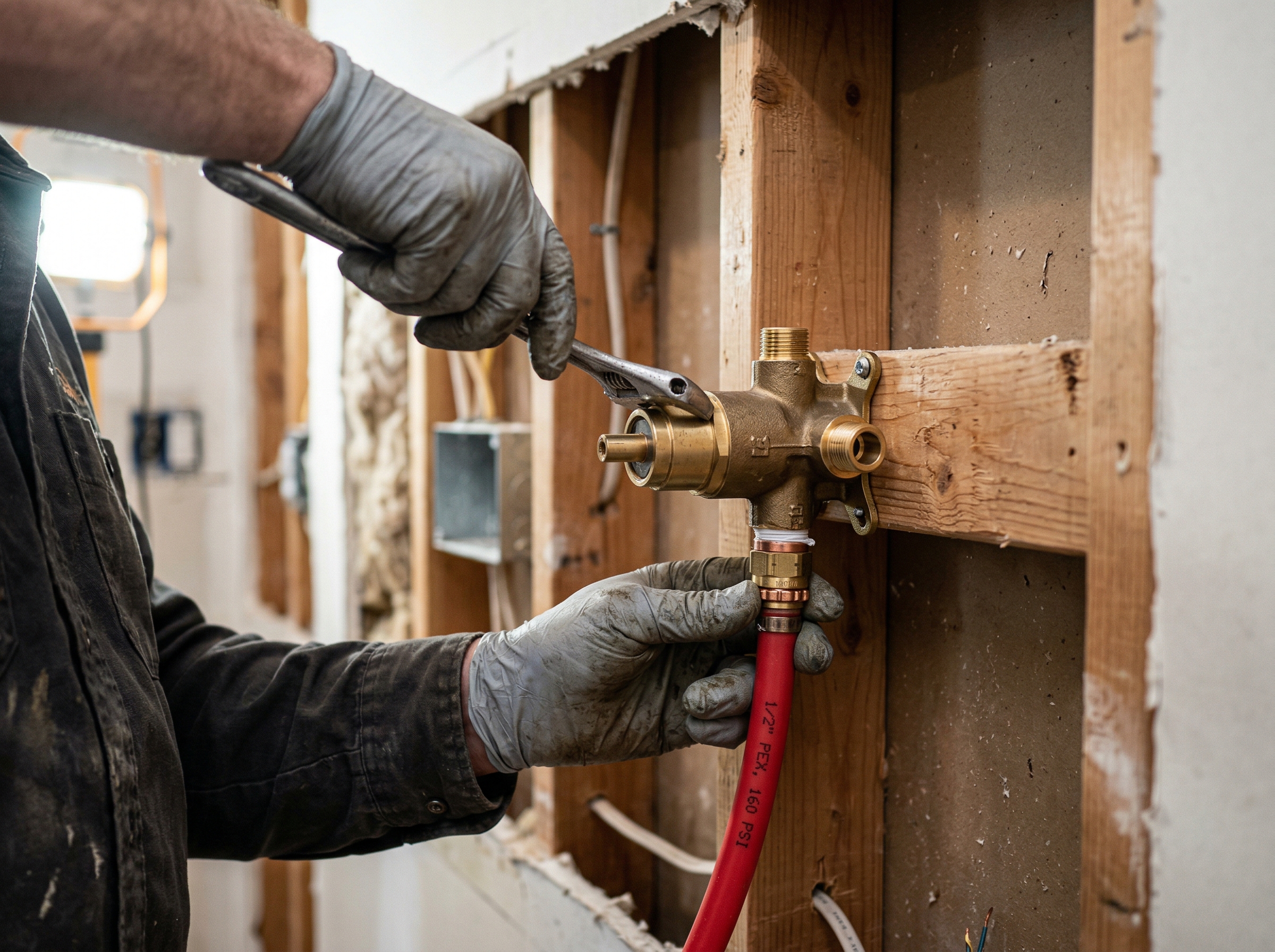
The cooktop wall backs onto a plumbing wet wall: a kitchen sink, a powder room, a laundry, or a bathroom directly behind the range. The plumber taps into the cold supply, runs PEX through the stud cavity, and stubs out the rough-in valve at the right height. Drywall opens for one stud bay, the tile setter cuts one hole in the new backsplash, the faucet mounts, done.
Medium run ($900 to $1,800 all-in)
The cooktop is on an exterior wall or an interior wall with no nearby cold supply. The plumber runs PEX through the basement ceiling joists from the nearest cold line, drills up through the bottom plate, and chases through 6 to 12 feet of stud bays to reach the rough-in. This adds 3 to 6 hours of plumber labour, drywall patches in two or three additional rooms, and basement ceiling drywall removal and replacement if the basement is finished.
Nightmare run ($1,800 to $4,500+)
Two-storey home, cooktop on the second floor or in a kitchen with a finished basement below and an exterior wall behind. The plumber has to fish a long supply through joist bays, soffit around obstructions, or open up a finished ceiling. Add a freezing-risk concern if the supply runs along an uninsulated exterior wall, which means the line either gets foam-sleeved or rerouted entirely. This is the bucket where homeowners cancel the pot filler and put a tall vessel on the regular sink instead.
Drywall, tile, and the hidden costs
The faucet itself is $200 to $1,200 retail depending on brand and finish. Plumbing labour is $400 to $1,500. The hidden cost everyone forgets is the drywall and tile work: every wall the plumber opens has to be patched, primed, painted to match, and re-tiled. On a new backsplash going in fresh, that is no extra work. On an existing backsplash you want to preserve, the cost of cutting the matching tile (and hoping the run is still in stock) can exceed the plumbing cost.
The honest scheduling rule: only install a pot filler during a full kitchen renovation when the wall is already open, the backsplash is brand new, and the rough-in costs nothing extra to add. Retrofitting one into an existing kitchen is almost always a bad value.
Code requirements in Ontario
Pot fillers are governed by the Ontario Building Code Part 7 (plumbing) and the local municipal plumbing bylaw. Three things matter:
- Backflow prevention. The rough-in valve must include a check valve or atmospheric vacuum breaker to prevent pot water from siphoning back into the cold supply. Most modern pot filler valves have this built in. Cheap imports often do not.
- Shutoff access. An accessible shutoff valve must be reachable behind the cabinetry or in the basement directly below. The faucet’s own handle does not count as the shutoff for code.
- No drain required. Pot fillers do not need a drain because they only run when actively filling a pot. This is the one part of the code that makes pot fillers cheaper than other specialty fixtures.
Mounting height and reach
The arm length and mounting height matter more than the brand. Get this wrong and the faucet will not reach the centre of your largest pot, or it will hit the range hood every time it folds out. The standard rule:
- Mount the faucet 18 to 24 inches above the cooktop surface. Lower if your largest stockpot is short, higher if you regularly use a 12 quart pot.
- Pick an arm length 4 to 6 inches longer than the distance from the wall to the centre of your largest burner. Most GTA gas ranges put the back burners 12 to 14 inches off the wall, so a 16 to 20 inch combined arm reach is standard.
- Confirm the arm clears the range hood when folded out. Wall-mounted hoods often hang into the swing path of cheaper pot fillers.
Brands worth specifying in the GTA
Stick to North American brands with parts availability and a real warranty. Moen, Delta, Kohler, Brizo, and Riobel all sell pot fillers in Canada with full parts support. Imported off-brand units from online marketplaces routinely show up with the wrong inlet thread, missing backflow valves, or warranty claims that route to overseas manufacturers. The price savings of $150 are not worth the headache when a fitting fails behind a freshly tiled backsplash.
The honest verdict
If you cook actual stockpot meals more than twice a month, your renovation already includes a new backsplash, and the cooktop wall has a short plumbing run, install the pot filler. It will cost you $600 to $1,200 in real terms and you will use it for 20 years.
If your cooking is mostly pasta from a box and the cooktop sits on a bad wall, skip it. Buy a tall vessel pitcher, mount a heated towel rail in the bathroom with the saved budget, and never think about it again.
Frequently asked questions
Do pot fillers leak inside the wall?
A properly installed brass or stainless rough-in valve with a quality faucet does not leak. Cheap import valves with plastic bodies and undersized O-rings absolutely do. The risk is real but it tracks the cost of the parts. Stick to name-brand valves and the leak risk is no higher than any other plumbing fitting.
Should the pot filler have hot water too?
No. Almost all pot fillers are cold water only. Cold water heats faster on a high-output gas burner than warm tap water makes a difference at the pot, and skipping the hot supply cuts the install cost in half. Some specialty units include hot, but the value is marginal.
Can I install one over an electric or induction cooktop?
Yes. Pot fillers are agnostic to the cooktop fuel. The clearance rules and the height rules are identical.
What height is the rough-in valve?
The valve centre line should be 24 to 28 inches above the finished cooktop surface, depending on the faucet height of the model you are buying. Specify the model before the rough-in goes in. Switching brands after rough-in usually means re-doing the wall.
Will the building inspector care?
Yes, on a permitted renovation. The plumbing rough-in inspection in most GTA municipalities requires the inspector to verify backflow prevention and accessible shutoff. Get the right valve up front and the inspection takes 30 seconds.
Plan your kitchen plumbing rough-in before the drywall closes up
Pot fillers are a small fixture with an outsized installation footprint. The right call depends on what is in the wall behind your cooktop and whether your renovation already opens that wall. request a free quote and we will look at your floor plan, walk the cold supply path, and tell you whether the pot filler belongs in your scope or whether the budget is better spent elsewhere.
Note: All renovation costs are approximate and may vary based on scope, materials, and site conditions- contact us for a detailed quote tailored to your project.