Listen to this article as a podcast
What Mississauga Inspectors Look For During a Kitchen Renovation – Podcast
Listen to this article on the go. Two-host conversation covering everything below.
In this article
- Day 1: what happens before construction starts
- The rough-in inspection: bones of the build
- The final inspection: walking the finished kitchen
- Rough-in vs final inspection at a glance
- Common pass and fail issues in Mississauga kitchens
- What “done” actually looks like
- Frequently asked questions
- Sources and references
The City of Mississauga states it plainly on its own building permit page: building inspections are a mandatory part of the approval process for all construction, including renovation. That single line, sitting on the official inspections page, is what most homeowners only discover halfway through a kitchen project. A kitchen renovation inspection Mississauga homeowners assume is optional is, in fact, mandatory once your permit is open. It is a sequence of sign-offs that runs in parallel with the build, and the inspector decides when the next stage can start. Before any of this kicks in, you need the permit itself, which we walked through in our complete guide to kitchen renovation permits in Mississauga. This post picks up where that one stops: a stage-by-stage walk through the kitchen renovation inspection Mississauga inspectors actually run once the walls open.
The job of the city inspector is narrow and specific. They are not there to judge cabinet quality or backsplash colour. They are there to confirm that the work matches the approved drawings, follows the Ontario Building Code, and is safe to live with for the next forty years. That sounds simple. In practice it is where most kitchen renovation timelines stretch, because contractors who do not run a clean inspection schedule lose days to deficiency lists that could have been avoided.
Please note: This article is for general guidance only. Costs, regulations, and inspection procedures change. Kitchen and Bath Reno is not liable for outcomes from actions taken based on this content. Always confirm requirements with a Mississauga building inspector. Gas work requires a TSSA-licensed technician. Electrical work requires an ESA-permitted contractor. Use a licensed professional for your specific situation.
Day 1: what happens before construction starts
The first inspection on a Mississauga kitchen renovation happens before anyone swings a hammer. The City calls it an initial site inspection, and it exists for a reason most homeowners never hear about. The City’s own guidance says to book the initial site visit before starting any construction work, because that visit is where the inspector tells you which inspections your specific project actually needs and the order they must happen in. Two kitchen renovations on the same Mississauga street can need different inspection schedules depending on whether you are moving a wall, adding a window, or relocating gas.
On that first visit, your contractor should have the approved permit drawings on site. Not on a contractor’s laptop at home. On site. The inspector cross-references the drawings to what they see in the existing space and confirms the scope. If you are taking down a wall that turns out to be load-bearing, the inspector will catch that before you discover it the expensive way. The Ontario Building Code sets the rules; the inspector applies them to your actual house.
People often ask: does a kitchen reno always need a permit and inspection?
No, not always, but the line is narrower than most homeowners think. Mississauga’s list of when a permit is required includes interior alterations, kitchen exhaust changes, HVAC work, and adding or moving any plumbing fixture, including a sink. A new floor and a new paint colour do not require a permit. The moment a sink moves a foot to the left, it does.
The rough-in: stage one of any kitchen renovation inspection Mississauga homeowners book
Rough-in is the inspection most homeowners do not see coming. By the time the plumber and electrician have finished their first pass, the framing is up and the cavities are open. That is the only window the inspector has to verify what gets buried inside a wall. The City of Mississauga splits rough-ins into three pieces, plumbing, electrical, and HVAC, and they are usually inspected together but signed off separately.
Plumbing rough-in
The plumbing rough-in inspection has to be booked after the rough plumbing is installed between studs and before any drywall, gravel, or concrete goes over it. The inspector physically needs to see the traps, vents, and connections. According to the City’s guidance, every fixture and trap must be properly vented, with vents tying into the stack vent at a level higher than the fixture they serve. A washing machine standpipe, if your kitchen layout includes laundry, must be at the correct height with a proper trap.
Electrical rough-in
The electrical rough-in is inspected by the Electrical Safety Authority of Ontario, not by the city. The contractor pulls an ESA notification, and an ESA inspector reviews the work. Kitchens have the heaviest electrical load in the house: GFCI protection on counter outlets, dedicated circuits for the dishwasher, microwave, and refrigerator, and a 240 V circuit if you have an electric range or induction cooktop. AFCI breakers are required across most kitchen circuits under the current Ontario Electrical Safety Code.
HVAC rough-in
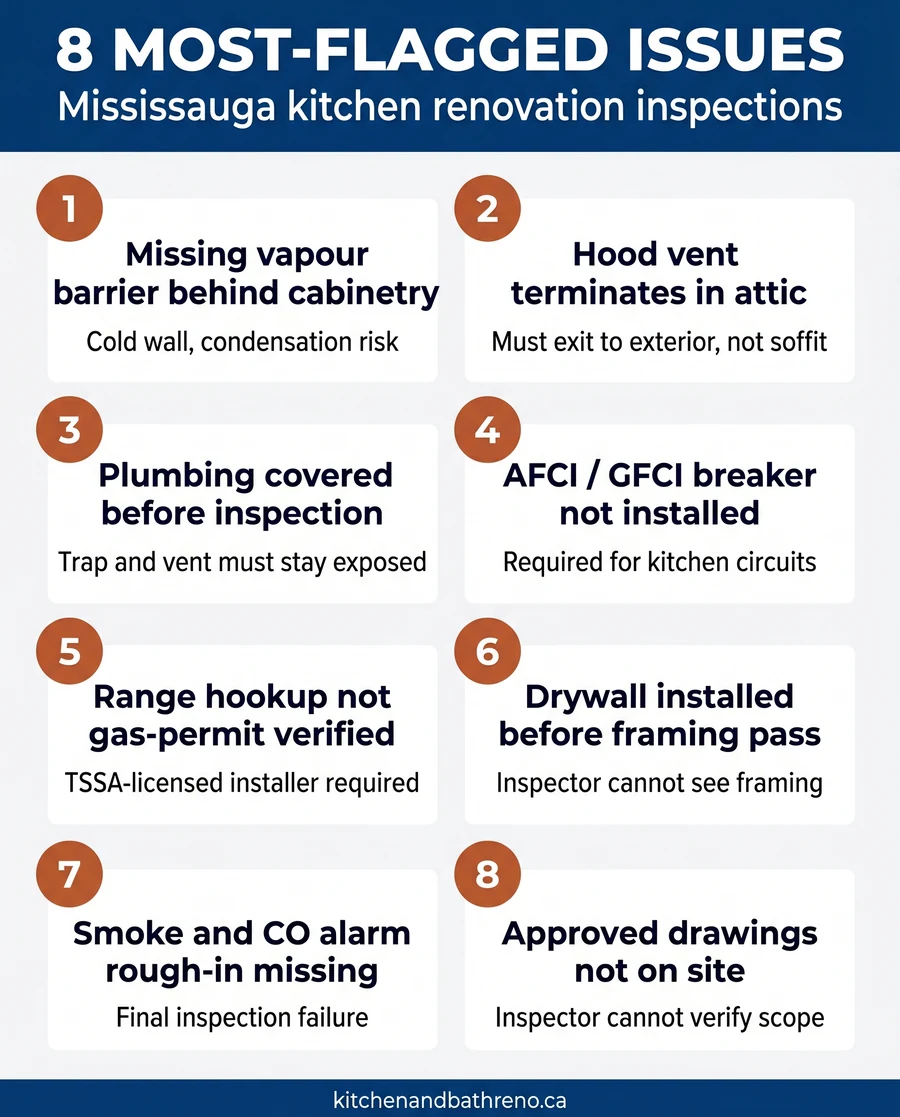
The HVAC rough-in covers any ductwork added or moved for the kitchen, plus the kitchen hood vent and bathroom fan ducts if the project includes a powder room rebuild. The City’s checklist is specific: ductwork is correctly installed, pipes and vents are visible, bathroom fans are insulated where required, and they terminate at the exterior of the building. The kitchen hood exhaust duct cannot terminate at the soffit. This is one of the most common failures in Mississauga kitchen reno inspections, because a contractor cutting corners will route the hood vent into the attic, where moisture and grease build up. Inspectors catch it every time.
Pro tip: never let drywall start before all three rough-ins pass
The single fastest way to turn a six-week kitchen into a three-month project is letting drywall close up a wall the inspector still needs to see. We have audited renovations in Mississauga where the framer was already hanging drywall when the plumbing inspector arrived. The inspector left, the wall came back down, the schedule slipped two weeks, and the homeowner paid for the labour twice. The Mississauga inspection checklist makes the rule unmistakable: insulation and drywall do not get installed until the rough-ins are signed off.
Framing inspection
The framing inspection is a separate sign-off that happens after the rough-ins clear. The City checks that fire blocks and firestopping are in place inside concealed spaces, that ceiling heights and room dimensions match the approved drawings, and that any new framing above window and door openings matches what was permitted. Smoke alarm and CO detector rough-ins must be complete at this stage. A gasket approved under the Ontario Building Code separates wood from any basement floor, which matters if your kitchen renovation extends into a finished lower level.
The final inspection: walking the finished kitchen
The final building inspection is the last sign-off. The City’s own guidance lists the prerequisites: all previous inspections passed, work is complete in accordance with the approved drawings, and any previously identified deficiencies have been addressed. Only then can the inspector book a final walk. Plumbing fixtures must be installed and operational, with correct hot on the left and cold on the right orientation, no visible leaks, traps in place, and access maintained to backwater valves and cleanouts. The hot water tank, if it was replaced as part of the project, is checked. Smoke alarms and CO detectors are tested.
For a kitchen specifically, the inspector pays attention to a short list of finishes: the range hood is connected and operating, the dishwasher drain line includes an air gap or high loop, the GFCI outlets test correctly under load, and any gas range hookup has the matching TSSA-permitted documentation. Caulking around the sink and backsplash, exterior grading where any new venting penetrates the wall, and gas-proofing details all factor into the pass.
Red flag: if your contractor offers to “skip the final”
A licensed Mississauga renovator will never suggest skipping the final inspection. Once the permit is open with the City, it has to be closed with a final sign-off or it sits as an open permit against the property forever. Open permits surface during the title search when you sell the house, and they can stall or sink the closing. Anyone willing to leave that loose is a contractor you should not be working with. Verify your gas technician on the TSSA fuels contractor lookup and your electrician through the ESA before the work starts.
Rough-in vs final inspection at a glance
Two inspections, two very different scopes. The rough-in lives inside the wall. The final lives in the finished room. Here is the side by side for a typical Mississauga kitchen renovation.
| Rough-in inspection | Final inspection | |
|---|---|---|
| When in the project | After framing, plumbing, electrical, and HVAC are run. Before drywall. | After cabinets, countertops, fixtures, and appliances are installed. |
| What inspectors check | Vent stack heights, trap placement, GFCI/AFCI breakers, duct runs, hood exhaust path, framing matches drawings. | Hot and cold orientation, leak-free fixtures, smoke and CO detectors, gas appliance connections, finished safety features. |
| Common pass / fail issues | Plumbing covered too early, hood vent into attic, missing GFCI on counter circuits, drywall installed before sign-off. | Smoke/CO detector missing, dishwasher drain lacks air gap, unverified gas connection, exterior caulking incomplete. |
| Typical timing | Booked 1 to 3 business days in advance. Pass result on the day of inspection. | Booked when all trades sign off. Same-day pass or deficiency list. |
| Who books it | Your contractor, via the City’s online booking portal. | Your contractor or you, once every prior stage is signed off. |
Source: City of Mississauga building permit inspections.
Common pass and fail issues during a kitchen renovation inspection in Mississauga
The City of Mississauga publishes its inspection checklists publicly. Reading them tells you exactly where most kitchen renos go sideways. The same issues come up across kitchen renovation projects we have audited in Mississauga, Oakville, and Brampton. They are not exotic. They are the same eight or ten items, ignored by busy contractors, that turn into deficiency lists.
- Hood vent routed to the soffit or attic. The Mississauga checklist requires kitchen hood exhaust to exit to the exterior of the building. Soffit termination dumps cooking moisture back into the eaves. Attic termination is worse. Inspectors flag it on the first walk.
- Missing GFCI on kitchen counter outlets. Required by the Ontario Electrical Safety Code, verified by ESA. A reno where the old non-GFCI outlets stay in place will fail electrical sign-off.
- Plumbing covered before inspection. Drywall or vapour barrier installed over rough-in plumbing forces a tear-out. Some inspectors will not accept photographs as proof, the plumbing must be visible.
- Gas range hookup without a TSSA-licensed installer. A handyman cannot make this connection. The work is regulated under the Technical Standards and Safety Act. Verify your installer on the TSSA fuels contractor lookup before they touch your gas line.
- Approved drawings not on site. The City inspector needs to compare what is built to what was approved. No drawings on site is a same-day fail.
- Smoke and CO detector rough-ins missing. Even though your kitchen renovation is one room, the smoke and CO alarm rough-ins are checked at the framing stage. Forgotten rough-ins turn into a final inspection fail months later.
- Dishwasher drain without an air gap or high loop. Common on quick renos where the plumber assumes a code-minimum installation is enough. The inspector wants either an air gap fitting at the counter or a clearly looped drain line.
- Open permits left by previous owners. If your home has open permits from past renovations, those can affect the current inspection schedule. The City’s online building permit application status tool surfaces them.
What “done” actually looks like
A Mississauga kitchen renovation is not done when the cabinets are installed. It is done when the City inspector signs the final pass and the permit closes. That signed-off permit is what protects your home insurance claim if something goes wrong in five years. It is what shows up clean on a title search when you sell. It is the difference between a finished kitchen and an asset.

If you are weighing how much of the inspection burden falls on you vs your contractor, the honest answer is that a good renovator owns the inspection schedule end to end. We cover this in our companion post on kitchen renovation costs in Mississauga, where the inspection-related overhead is built into a transparent estimate. Anyone quoting a kitchen at a price that ignores inspection coordination is quoting a number that will grow.
Download the free pre-inspection checklist
A printable 3-page checklist covering everything to verify before you call the Mississauga inspector. Built from the City’s own published criteria.
Mississauga kitchen reno pre-inspection checklist (PDF)Frequently asked questions
Sources and references
- City of Mississauga, Book a building permit inspection. Official inspection types, scheduling, and pass/fail criteria.
- City of Mississauga, Building permits overview.
- City of Mississauga, When a building permit is required.
- Government of Ontario, Ontario’s Building Code.
- Electrical Safety Authority of Ontario, ESA homeowner and contractor resources.
- Technical Standards and Safety Authority, TSSA fuels contractor lookup.
More reading for Mississauga renovators
If you are planning a kitchen renovation in Mississauga, Oakville, or Brampton and you want a contractor who owns the inspection schedule from initial site visit to final sign-off, book a consultation with Kitchen and Bath Reno. We will walk you through the inspection schedule before any drawings get drafted, so the timeline you sign off on is the timeline you actually get.